All published articles of this journal are available on ScienceDirect.

Safety Culture and Job Satisfaction and their Associations with Adverse Event Reporting Attitudes among Nurses in Indonesian Community Health Centers
 iD
Evi Harwiati Ningrum1
iD
Shila Wisnasari1
iD
Ismulia Aldama Susanto2
Mercy Nkeiruka2
Alfrina Hany1
iD
Ratih Arum Vatmasari3
iD
iD
Evi Harwiati Ningrum1
iD
Shila Wisnasari1
iD
Ismulia Aldama Susanto2
Mercy Nkeiruka2
Alfrina Hany1
iD
Ratih Arum Vatmasari3
iD
Authors Info & Affiliations
Abstract
Introduction
Adverse event reporting is essential for identifying system weaknesses, promoting organizational learning, and improving patient safety. However, evidence on the relationships among patient safety culture, job satisfaction, and attitudes toward adverse event reporting in primary care settings remains limited, particularly in Indonesian community health centers. This study examined the relationships among patient safety culture, job satisfaction, and attitudes toward adverse event reporting among nurses working in Indonesian community health centers.
Methods
This cross-sectional study involved 359 nurses from 44 community health centers in Malang, Indonesia. Data were collected using the Safety Attitudes Questionnaire (SAQ), the Job Satisfaction Survey (JSS), and the Reporting of Clinical Adverse Events Scale (RoCAES), and analyzed using descriptive statistics and path analysis.
Results
Patient safety culture was positively associated with job satisfaction (β = 0.447, p < 0.001). Job satisfaction was positively associated with adverse event reporting attitudes (β = 0.530, p < 0.001). However, patient safety culture was not directly associated with adverse event reporting attitudes (β = -0.037, p = 0.500).
Discussion
A stronger patient safety culture appears to translate into more favorable reporting attitudes mainly through its influence on job satisfaction, rather than through a direct effect. This suggests that a supportive safety climate alone may not be sufficient to strengthen reporting behavior unless nurses also experience satisfaction with their day-to-day working conditions, highlighting job satisfaction as a key mechanism linking safety culture to reporting attitudes among nurses in community health centers.
Conclusion
A stronger patient safety culture may indirectly improve attitudes toward adverse event reporting through enhanced job satisfaction. Strategies to improve reporting in community health centers should therefore combine efforts to strengthen safety culture with practical interventions that improve nurses’ job satisfaction, managerial support, and psychological safety.
1. INTRODUCTION
Patient safety remains a primary objective of high-quality health care systems, yet unintended patient injury persists across care settings despite advances in practice standards [1, 2]. The prevalence of adverse events underscores the fundamental significance of enhancing patient safety within healthcare environments [3, 4]. Adverse events are defined as unanticipated injuries or complications caused by medical management rather than the patient’s underlying condition [5].
Safety culture in primary health care is vital for preventing adverse events and ensuring the provision of high-quality care [6]. Primary health care is the initial point of contact for the majority of patients and, as such, is essential to the global health system [7]. Nevertheless, research on patient safety in primary care has historically lagged behind that in hospital settings, with comparatively fewer studies of safety culture and reporting practices in primary care [8, 9].
Adverse event reporting is a critical approach for identifying system vulnerabilities, learning from errors, and averting their recurrence [10, 11]. Nevertheless, the organizational climate in which health professionals operate significantly influences the effectiveness of reporting systems [12, 13]. Staff may dread blame, perceive reporting as burdensome, or doubt that reported events will lead to meaningful change, which is why underreporting persists across numerous settings [14, 15]. Organizational and professional factors, such as safety culture, collaboration, and managerial support, continue to influence nurses' attitudes toward adverse event reporting [12, 16].
Job satisfaction is another factor that is likely to affect reporting attitudes. Nurses who are content with their positions are more likely to feel supported, valued, and engaged with organizational objectives, including patient safety [17]. Professional commitment, enhanced work behaviors, and superior quality of care have been associated with job satisfaction [18]. Additionally, emerging evidence suggests that job satisfaction may serve as an intermediary pathway through which organizational conditions influence safety outcomes and adverse event-related measures [19].
Although relationships among safety culture, job satisfaction, and adverse event reporting have been explored in hospital-based studies, evidence from community health centers and primary care settings remains limited. This represents a critical knowledge gap, given the significant differences between primary care and hospitals in structure, workflow, staffing patterns, and reporting challenges [20]. Even though community health centers are essential components of the national health system and serve a significant portion of the population, there is still a scarcity of published evidence regarding patient safety reporting in Indonesia [20-22]. Consequently, it is imperative to develop a more comprehensive understanding of the organizational factors that are linked to adverse event reporting attitudes in this context [23]. Accordingly, this study aimed to examine the relationships among patient safety culture, job satisfaction, and attitudes toward adverse event reporting among nurses working in Indonesian community health centers.
2. METHODS
2.1. Study Design
This study employed an observational analytic design with a cross-sectional approach.
2.2. Setting and Participants
The study was conducted in 44 community health centers in Malang Regency and Malang City, Indonesia. The target population comprised nurses working in these facilities. Participants were recruited using consecutive sampling. Nurses were eligible if they had worked for at least one year, were directly involved in patient care, and were willing to participate. Nurses who were absent during the data collection period were excluded. A total of 359 nurses were included in the study.
2.3. Measures
Data were collected using three standardized self-administered questionnaires. Patient safety culture was assessed using the Safety Attitudes Questionnaire (SAQ), originally developed by Sexton et al. [24], which measures six domains of safety climate: teamwork climate, safety climate, perceptions of management, job satisfaction, working conditions, and stress recognition. This study used the Indonesian-language version of the SAQ (SAQ-INA), translated through forward-backward translation and validated using Rasch analysis by Ningrum et al. [25]. For the present study, the validity and reliability of the SAQ-INA were re-confirmed in a pilot sample of 30 nurses not included in the main study sample, using Pearson product-moment correlation (r table = 0.296) for validity and Cronbach’s alpha for reliability; all 36 items tested were valid (r calculated > r table), and the instrument demonstrated excellent internal consistency (Cronbach’s α = 0.962). Job satisfaction was measured using the Job Satisfaction Survey (JSS), originally developed by Spector [26], comprising nine sub-dimensions (salary, promotion, fringe benefits, contingent rewards, supervision, operating procedures, co-workers, nature of work, and communication). The Indonesian-language JSS application used in this study has previously demonstrated good internal consistency in Indonesian nursing populations (Cronbach’s α = 0.907) [27]. Attitudes toward adverse event reporting were measured using the Reporting of Clinical Adverse Events Scale (RoCAES). The validity and reliability of the RoCAES were tested in the same pilot sample of 30 nurses using the same procedures described above; all 25 items were valid (r calculated > r table = 0.296), and the instrument demonstrated good internal consistency (Cronbach’s α = 0.910). These instruments have been widely used in health services research to assess organizational safety climate, employee job satisfaction, and reporting attitudes.
2.4. Data Analysis
Data were analyzed using IBM SPSS Statistics version 25. Descriptive statistics were used to summarize demographic characteristics and study variables. Path analysis was performed to examine the direct and indirect relationships among patient safety culture, job satisfaction, and attitudes toward adverse event reporting. Statistical significance was set at p < 0.05.
2.5. Ethical Considerations
This study was approved by the Health Research Ethics Commission of the Faculty of Health Sciences, Universitas Brawijaya, Indonesia (No. 8962/UN10.F17.10.4/TU/2023). The study was conducted in accordance with the ethical principles of the Declaration of Helsinki for research involving human participants. All participants provided informed consent and were informed about the study objectives, confidentiality protections, and their right to withdraw at any time without penalty.
3. RESULTS
A total of 359 nurses participated in the study. The mean age of respondents was 38.0 years (SD = 7.04). Most participants were female (76.3%). Regarding educational level, 62.7% held a diploma, 35.7% held a bachelor’s degree, and 1.7% held a master’s degree. Most respondents had more than 10 years of work experience (63.8%) (Table 1).
| Variable | Category | n (%) |
|---|---|---|
| Age (years) | Mean ± SD | 38.0 ± 7.04 |
| Gender | Female | 274 (76.3) |
| Male | 85 (23.7) | |
| Educational level | Diploma | 225 (62.7) |
| Bachelor’s degree | 128 (35.7) | |
| Master’s degree | 6 (1.7) | |
| Length of work | 1–5 years | 60 (16.7) |
| 6–10 years | 70 (19.5) | |
| >10 years | 229 (63.8) |
The mean score for job satisfaction was 149.1 (SD = 20.3), followed by patient safety culture at 132.7 (SD = 19.6), and adverse event reporting attitudes at 69.9 (SD = 8.27) (Table 2).
| Variable | Mean ± SD |
|---|---|
| Patient safety culture | 132.7 ± 19.6 |
| Job satisfaction | 149.1 ± 20.3 |
| Adverse event reporting attitudes | 69.9 ± 8.27 |
Table 3 shows that patient safety culture was positively associated with job satisfaction (β = 0.447, p < 0.001), indicating that nurses who perceived a better safety culture also reported higher job satisfaction. Job satisfaction was positively associated with adverse event reporting attitudes (β = 0.530, p < 0.001), suggesting that higher job satisfaction was related to stronger reporting attitudes. However, patient safety culture was not directly associated with attitudes toward adverse event reporting (β = -0.037, p = 0.500), indicating that safety culture alone did not significantly predict these attitudes. These findings suggest that job satisfaction may play an important intermediary role in linking patient safety culture to nurses' attitudes toward adverse event reporting in community health centers. The indirect effect of patient safety culture on adverse event reporting attitudes through job satisfaction (axb) = 0.237 was tested using the Sobel test and found to be statistically significant (z = 7.332, p < 0.001), confirming full mediation by job satisfaction.
| Path | Standardized β | p-value |
|---|---|---|
| Safety culture → Job satisfaction | 0.447 | <0.001 |
| Job satisfaction → Adverse event reporting attitudes | 0.530 | <0.001 |
| Safety culture → Adverse event reporting attitudes | -0.037 | 0.500 |
| Indirect effect: Safety culture → Job satisfaction → Adverse event reporting attitudes | 0.237 | z = 7.332, p < 0.001 |
Figure 1 shows that the path analysis indicated that patient safety culture was positively associated with job satisfaction. Job satisfaction, in turn, was positively associated with attitudes toward adverse event reporting. However, the direct relationship between patient safety culture and attitudes toward adverse event reporting was not statistically significant. Overall, the findings suggest that job satisfaction may act as an important intermediary mechanism through which safety culture is translated into more favorable reporting attitudes among nurses in community health centers.
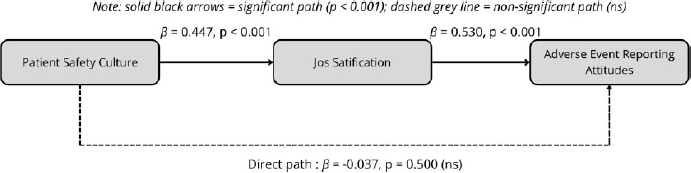
Path model showing the relationships among patient safety culture, job satisfaction, and adverse event reporting attitudes among nurses in community health centers.
4. DISCUSSION
This study examined the relationships among patient safety culture, job satisfaction, and attitudes toward adverse event reporting among nurses in Indonesian community health centers. The findings indicate that patient safety culture was positively associated with job satisfaction, and job satisfaction was positively associated with adverse event reporting attitudes. By contrast, the direct relationship between patient safety culture and attitudes toward adverse event reporting was not statistically significant. A Sobel test confirmed that this indirect effect was statistically significant (z = 7.332, p < .001), indicating that job satisfaction fully mediates the relationship between patient safety culture and adverse event reporting attitudes in this sample.
The positive correlation between job satisfaction and patient safety culture is in accordance with the broader body of evidence indicating that supportive organizational environments enhance staff morale, engagement, and retention [28, 29]. In environments that prioritize trust, open communication, collaboration, and supportive leadership, nurses are considerably more inclined to experience psychological security and appreciation [30]. These circumstances can enhance job satisfaction and foster greater dedication to the organization's objectives, including patient safety [31]. In recent years, studies have consistently demonstrated that a more effective safety culture is associated with improved staff outcomes, including reduced intention to leave and increased satisfaction [32, 33].
The finding that job satisfaction was positively associated with attitudes toward adverse event reporting is also plausible from an organizational behavior perspective [28, 29]. Nurses who are more content with their work environment may be more inclined to participate in extra-role behaviors that promote quality improvement, such as reporting incidents, near misses, or hazardous conditions [34, 35]. Additionally, they may experience greater assurance that their concerns will be acknowledged and addressed [36]. Recent studies indicate that the relationship between adverse event-related outcomes and workplace conditions can be mediated by work satisfaction and related organizational factors [37, 38].
Interestingly, this study did not identify a substantial direct correlation between attitudes toward adverse event reporting and patient safety culture. This may suggest that a positive safety milieu alone is insufficient to foster more robust reporting attitudes among employees unless they also experience supportive day-to-day working conditions [5, 39, 40]. In practice, organizations may formally endorse safety values, yet they still encounter obstacles that impede reporting, such as complex reporting procedures, heavy workloads, limited feedback, or a persistent fear of blame [41, 42]. Similarly, prior studies have demonstrated that reporting behavior is influenced by a variety of contextual barriers and that non-punitive environments are crucial for the successful implementation of safety culture [43, 44].
These findings have important implications for patient safety improvement in community health centers. Efforts to improve reporting should not focus only on technical reporting systems or policy mandates [45]. They should also address workforce experience by strengthening managerial support, simplifying reporting procedures, providing meaningful feedback after reports are submitted, and fostering a just and non-punitive culture [46-48]. The broader global patient safety agenda likewise emphasizes reporting and learning systems, workforce capability, and system-level support as critical elements for reducing avoidable harm [49-51].
This study contributes to the literature by focusing on community health centers, a setting that remains underrepresented in patient safety research compared with hospitals. It also adds evidence from Indonesia, where published data on patient safety culture and adverse event reporting in primary care remain limited. Given the central role of community health centers in delivering front-line services, strengthening organizational conditions for reporting may help support safer and more responsive primary health care.
5. STUDY LIMITATIONS
This study has several limitations. First, the cross-sectional design precludes causal inference; therefore, the findings should be interpreted as associations rather than causal effects. Second, the use of self-reported questionnaires may have introduced recall bias and social desirability bias. Third, the study was conducted in one geographic area, which may limit the generalizability of the findings to other primary care settings in Indonesia. Future studies using longitudinal designs and broader sampling frames are needed to confirm these relationships across different contexts.
CONCLUSION
This study highlights the importance of both patient safety culture and job satisfaction in shaping nurses' attitudes toward adverse event reporting in community health centers. A stronger patient safety culture was associated with higher job satisfaction, while job satisfaction was positively associated with reporting attitudes. However, patient safety culture did not show a significant direct association with attitudes toward adverse event reporting, suggesting that job satisfaction may serve as an important intermediary factor. Strengthening attitudes toward adverse event reporting in primary care may therefore require a dual strategy that combines safety culture improvement with practical efforts to enhance nurses’ job satisfaction and psychological safety.
AUTHORS’ CONTRIBUTIONS
The authors confirm their contributions to the manuscript as follows: K.R.P., E.H.N., S.W., and A.H.: Study conception and design; I.A.S., M.N., and R.A.V.: Data collection; K.R.P., E.H.N., S.W., and A.H.: Data analysis and interpretation of results; K.R.P., E.H.N., S.W., I.A.S., M.N., A.H., and R.A.V.: Draft manuscript preparation. All authors reviewed the results and approved the final version of the manuscript.
LIST OF ABBREVIATIONS
| JSS | = Job Satisfaction Survey |
| RoCAES | = Reporting of Clinical Adverse Events Scale |
| SAQ | = Safety Attitudes Questionnaire |
| SPSS | = Statistical Package for the Social Sciences |
ETHICS APPROVAL AND CONSENT TO PARTICIPATE
This study was approved by the Health Research Ethics Commission of the Faculty of Health Sciences, Universitas Brawijaya, Indonesia with the ethical code No. 8962/UN10.F17.10.4/TU/2023.
HUMAN AND ANIMAL RIGHTS
All procedures involving human participants were conducted in accordance with the ethical standards of the committee responsible for human experimentation (institutional and national), and with the Helsinki Declaration of 1975, as revised in 2013.
CONSENT FOR PUBLICATION
All participants provided informed consent and were informed about the study objectives, confidentiality protections, and their right to withdraw at any time without penalty.
AVAILABILITY OF DATA AND MATERIALS
The dataset supporting the findings of this study is not publicly available due to institutional data sharing restrictions but is available from the corresponding author upon reasonable request.
FUNDING
This study was funded by the Directorate of Research and Community Service (Direktorat Riset dan Pengabdian kepada Masyarakat), Universitas Brawijaya, Indonesia, Grant/Award Number: 00145.39/UN10.A0501/B/ PT.01.03.2/2024.
ACKNOWLEDGEMENTS
The authors would like to thank the nurses who participated in this study and the Faculty of Health Sciences, Universitas Brawijaya, Indonesia for their support of this research.