All published articles of this journal are available on ScienceDirect.

Assessment of Health-related Quality of Life in Multiple Sclerosis Patients at Azadi Teaching Hospital, Kirkuk City, Iraq
 iD
Jenan Akbar Shakoor1
iD
iD
Jenan Akbar Shakoor1
iD
Authors Info & Affiliations
Abstract
Introduction/Objective
Health-related quality of life (HRQoL) is a vital indicator of overall well-being, particularly in individuals with chronic illnesses such as multiple sclerosis (MS). Patients with MS often experience physical, emotional, and social challenges that significantly affect their HRQoL. Therefore, this study aimed to assess HRQoL among patients with MS in Kirkuk City.
Materials and Methods
This cross-sectional study included 135 patients with MS who were receiving treatment at the MS Consultation Unit of Azadi Teaching Hospital between January and April 2025. Participants were purposively sampled and interviewed face to face using a structured questionnaire that collected sociodemographic information, clinical data, and responses to the Multiple Sclerosis Quality of Life (MSQOL-54) scale. SPSS version 27 was used for statistical analyses, including descriptive and inferential statistics.
Results
A total of 135 patients with MS were included (77.8% female; mean age 36.96 ± 10.70. Most participants (63.0%) reported a fair level of HRQoL, while only 0.7% achieved an excellent level. The mean overall MSQOL score was 43.52 ± 11.18. Among the subdomains, social functioning (63.26 ± 12.30) and health perceptions (59.97 ± 11.94) showed the highest scores, whereas physical functioning had the lowest score (40.96 ± 20.76). No significant differences in overall HRQoL were observed across sociodemographic variables; however, disease duration was negatively correlated with overall HRQoL (r = -0.232, p-value = 0.007). Physical and mental health composite scores were strongly positively correlated with overall MSQOL (r =0.826, p-value < 0.001, and r = 0.895, p-value < 0.001, respectively).
Discussion
The findings indicate that HRQoL among patients with MS is substantially affected, particularly with increasing disease duration, highlighting the importance of sustained clinical and psychosocial support in routine care.
Conclusion
These findings highlight the need for healthcare interventions that address both the physical and mental health aspects in MS care to improve patients’ quality of life.
1. INTRODUCTION
Multiple sclerosis is a chronic inflammatory disorder that primarily affects the central nervous system (CNS). It is characterized by autoimmune-mediated degradation of myelin, the protective covering of nerve fibers. The disease commonly involves critical CNS regions such as the brainstem, spinal cord, optic nerve, and periventricular white matter, which are essential for vision, motor control, and sensory perception [1]. Despite extensive research, the exact cause of MS remains unknown. However, genetic factors, particularly specific alleles of the human leukocyte antigen (HLA) complex [2], along with environmental influences such as viral infections, vitamin D deficiency, smoking, and obesity, have been associated with its onset and progression [3-5].
Globally, MS affects approximately 2.8 million people, with an estimated prevalence of 35.9 per 100,000 individuals. Since 2013, prevalence rates have increased worldwide, although estimates vary across regions. In 75 reporting countries, the annual incidence is estimated at 2.1 per 100,000 individuals [6]. In Iraq, MS incidence has risen markedly, reaching 11.73 per 100.00 people, with rates observed among females (16.2 per 100,000) compared with males (7.3 per 100,000). This represents a substantial increase from 0.05 per 100,000 in 2000 to 1.5 per 100,000 in 2017 [7]. Neighboring countries, such as Turkey and Saudi Arabia, report even higher prevalence rates of 105.2 and 40.4 per 100,000, respectively [8, 9]. MS is also estimated to affect approximately 162 per 100,000 individuals in Iran [10].
Multiple sclerosis leads to significant morbidity through acute flare-ups that exacerbate symptoms and contribute to CNS lesion formation. These lesions result in scarring that disrupts brain function, leading to a wide range of physical, cognitive, and emotional impairments. Consequently, MS has a profound impact on patients’ quality of life (QoL) [2, 11]. Beyond physical disability, MS substantially reduces HRQoL, reflecting patients’ perceptions of how the disease and its treatment affect overall well-being and daily functioning [12].
A range of demographic, clinical, and psychological factors influence HRQoL in patients with MS. Fatigue, depression, mobility limitations, and cognitive dysfunction are among the most prominent contributors to reduced HRQoL. Research consistently demonstrates that individuals with MS experience significantly lower HRQoL compared with the general population [13, 14]. In addition, access to healthcare services, adherence to treatment, and supportive social environments play important roles in shaping HRQoL outcomes [15].
Despite growing international research on MS and QoL, studies examining these issues within the Iraqi context remain limited, particularly in Kirkuk City. Some previous research conducted in Iraq has assessed neurological imaging and QoL among patients with chronic diseases more broadly, offering valuable methodological and diagnostic insights [16]. However, the influence of sociodemographic and clinical factors on the HRQoL of MS patients within Iraq's unique cultural and healthcare environment remains underexplored. Given the increasing prevalence of MS in the region and ongoing challenges in accessing comprehensive healthcare, addressing this knowledge gap is essential. Therefore, this study aims to assess the HRQoL of MS patients at Azadi Teaching Hospital in Kirkuk City, with a particular focus on the relationships between sociodemographic characteristics, clinical features, disease duration, relapse frequency, and physical, mental, and overall HRQoL outcomes.
2. MATERIALS AND METHODS
2.1. Study Design
This quantitative cross-sectional study was conducted from January 10, 2025, to April 30, 2025.
2.2. Sample, Sampling, and Setting
The study included 135 patients diagnosed with MS who were receiving treatment at the MS Consultation Unit of Azadi Teaching Hospital, located in the southern part of Kirkuk City, Iraq. The hospital is a six-floor facility providing specialized healthcare services. Participants were selected using a purposive sampling. The MS Consultation Unit, established in 2022, operates on a fixed treatment schedule offering monthly, quarterly, or semiannual care depending on MS type and severity. Since its establishment, the unit has provided weekly follow-up care every Tuesday, ensuring consistent treatment, intervention, and medication administration.
2.3. Inclusion and Exclusion Criteria
Patients aged 16 years and older who consented orally to participate were included. Patients with severe cognitive impairments preventing comprehension or response to the questionnaire were excluded. Additionally, individuals diagnosed with other neurological disorders that could confound HRQOL results, such as attention deficit disorder (ADD), cerebral palsy, brain tumors, Bell’s palsy, or meningitis, were also excluded.
2.4. Data Collection
Data were collected through face-to-face interviews conducted weekly on Tuesdays. Each session lasted 25 to 35 minutes, with 5 to 6 participants interviewed per session. Participants completed a structured questionnaire covering sociodemographic information, clinical assessments, and the MSQOL scale. Oral informed consent was obtained before interviews, ensuring participants understood the study objectives and their right to withdraw without affecting their treatment.
Socio-demographic data included age, gender, employment status, economic status, educational level, and place of residence. Clinical data covered MS severity, disease duration, and relapse frequency. HRQoL was assessed using a standardized 54-item MSQOL questionnaire, adapted from the 36-item Short-Form Health Survey (SF-36) with 18 additional items. The original instrument by Vickrey et al in 1995 [17], was modified to 49 items by excluding the Sexual Function and Satisfaction domain (5 items) due to cultural sensitivity (Table 1).
| Dimension | Number of Items | Items |
|---|---|---|
| Mental Quality of Life (MQL) | - | - |
| Emotional well-being | 5 | 24,25,26,28,30 |
| Role limitations (Emotional) | 3 | 17,18,19 |
| Overall QoL | 2 | 48,49 |
| Cognitive functioning | 4 | 42,43,44,45 |
| Physical Quality of Life (PQL) | - | - |
| Pain | 3 | 21,22,47 |
| Role limitations (Physical) | 4 | 13,14,15,16 |
| Physical health | 10 | 3,4,5,6,7,8,9,10,11,12 |
| Social functioning | 3 | 20,33,46 |
| Energy/Fatigue | 5 | 23,27,29,31,32 |
| Health perceptions | 5 | 1,34,35,36,37 |
| Health-related distress | 5 | 2,38,39,40,41 |
Note: The MSQOL-49 is a modified version of the MSQOL-54 developed by Vickrey et al. (1995) [17], adapted by excluding five items related to sexual function and satisfaction to improve cultural sensitivity.
The MSQOL-49 assesses 11 dimensions of QoL, which are grouped into two primary domains: Mental Quality of Life (MQL) and Physical Quality of Life (PQL). The domains and their corresponding sub-dimensions are outlined in the table below:
2.5. Scoring System
Responses were converted to a 0–100 scale, with higher scores indicating better HRQoL. Each dimension’s score was calculated as the average of its items, and composite physical and mental health scores were derived by combining relevant domain scores. Missing responses were adjusted for accuracy. HRQoL scores were categorized into four levels based on percentile cut-offs:
| • Excellent QoL: ≥ 70 | • Fair QoL: 40-54.9 |
| • Good QoL: 55-69.9 | • Poor QoL: < 40 |
2.6. Statistical Analysis
Data analysis was performed using the Statistical Package for the Social Sciences (SPSS) version 27. Descriptive statistics summarized numerical data (mean, standard deviation, and range) and categorical data (frequency and percentage). One-way ANOVA tested differences in overall MSQOL scores across categorical variables with multiple groups, with η2 indicating effect size. Independent t-tests compared binary groups, with Cohen’s d to measure effect size. Pearson correlation assessed associations among continuous variables, with r2 representing explained variance. Statistical significance was set at p-value < 0.05.
2.7. Ethical Considerations
Ethical approval was obtained from the Kirkuk Nursing College's Ethical Scientific Committee (Approval No. 3279/2/7, dated 16/12/2024), the Kirkuk Health Directorate, and the Azadi Teaching Hospital MS Consultation Unit (Approval No. 8 dated 7/1/2025). The study adhered to ethical standards by maintaining patient anonymity and confidentiality throughout data collection, storage, and analysis.
3. RESULTS
A total of 135 patients diagnosed with MS participated in the study. The mean age of participants was 36.96 ± 10.70 years (range: 16-67 years), and the majority were female (77.8%).
Regarding HRQoL categories, most participants reported a fair level of overall MSQOL 85 (63.0%), followed by good 36 (26.7%) and poor 13 (9.6%) levels. Only one participant (0.7%) reported an excellent level of HRQoL (Fig. 1).
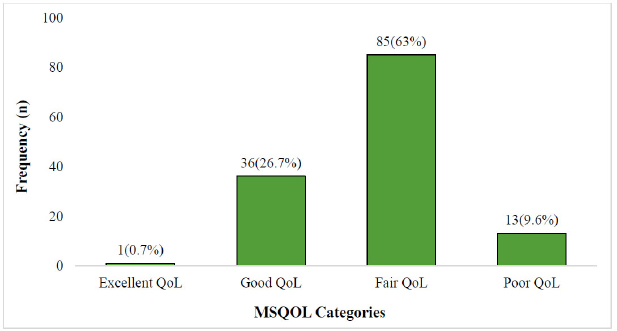
Distribution of overall MSQOL categories among the study participants (N = 135).
The x-axis represents MSQOL categories (excellent, good, fair, and poor), while the y-axis represents the number of participants in each category. Values above bars indicate frequency and percentage.
Descriptive statistics for MSQOL subdomains are presented in Table 2. The highest mean scores were observed in social functioning (63.26 ± 12.30), health perceptions (59.97 ± 11.94) and cognitive functioning (54.04 ± 11.96). Emotional well-being (52.74 ± 13.66), pain (52.10 ± 13.95), energy/fatigue (50.46 ± 19.52), and health distress (50.96 ± 10.61) showed moderate effects. Physical functioning showed the lowest mean score (40.96 ± 20.76), along with role limitations due to physical (41.85 ± 27.46) and emotional problems (42.72 ± 38.34). The overall MSQOL score was 43.52 ±11.18, ranging from 20 to 68.
| Subdomains | M ± SD | Minimum – Maximum |
|---|---|---|
| Physical functioning | 40.96 ± 20.76 | 0 – 90 |
| Role limitations (physical) | 41.85 ± 27.46 | 0 – 100 |
| Role limitations (emotional) | 42.72 ± 38.34 | 0 – 100 |
| Pain | 52.10 ± 13.95 | 20 – 87 |
| Emotional well-being | 52.74 ± 13.66 | 20 – 84 |
| Energy/fatigue | 50.46 ± 19.52 | 0 – 100 |
| Health perceptions | 59.97 ± 11.94 | 30 – 85 |
| Social functioning | 63.26 ± 12.30 | 33 – 93 |
| Cognitive functioning | 54.04 ± 11.96 | 25 – 85 |
| Health distress | 50.96 ± 10.61 | 20 – 75 |
| Overall QoL | 43.52 ± 11.18 | 20 – 68 |
Note: M= Mean, SD=standard deviation.
No statistically significant differences in overall MSQOL were observed across sociodemographic variables, including age groups (p-value = 0.782, η2 = 0.013), gender (p-value = 0.399, d = 0.16), place of residence (urban vs. rural; p-value = 0.102, d = 0.35), employment status (p-value = 0.068, d = 0.39), marital status (p-value = 0.993, η2 = 0.006), educational level (p-value = 0.664, η2 =0.01), and income (p-value = 0.849, η2 = 0.006), all with small or negligible effect sizes (Table 3).
| Variables | N | M ± SD | Test Statistic | p-value | Effect Size |
|---|---|---|---|---|---|
| Age (Years) | |||||
| 16-25 | 16 | 49.89 ± 8.166 | F = 0.436 | 0.782 | η2 = 0.013 |
| 26-35 | 48 | 50.26 ± 7.802 | |||
| 36-45 | 46 | 50.99 ± 9.661 | |||
| 46-55 | 16 | 47.74 ± 6.985 | |||
| > 55 | 9 | 49.14 ± 9.947 | |||
| Sex | |||||
| Male | 30 | 51.30 ± 10.10 | t = 0.845 | 0.399 | d = 0.16 |
| Female | 105 | 49.81 ± 8.028 | |||
| Residency | |||||
| Urban | 114 | 49.62 ± 8.043 | t = 1.649 | 0.102 | d = 0.35 |
| Rural | 21 | 52.93 ± 10.51 | |||
| Employment Status | |||||
| Unemployed | 32 | 47.74 ± 7.497 | t = 1.842 | 0.068 | d = 0.39 |
| Employed | 103 | 50.88 ± 8.705 | |||
| Marital status | |||||
| Married | 112 | 50.22 ± 8.493 | F = 0.031 | 0.993 | η2 = 0.006 |
| Single | 21 | 49.83 ± 9.219 | |||
| Divorced | 1 | 48.65 | |||
| Widow | 1 | 48.77 | |||
| Educational level | |||||
| Illiterate | 14 | 49.89 ± 8.040 | F = 0.528 | 0.664 | η2 = 0.01 |
| Primary school completed | 22 | 48.53 ± 8.236 | |||
| Secondary school completed | 36 | 49.66 ± 8.816 | |||
| Tertiary | 63 | 51.03 ± 8.625 | |||
| Income | |||||
| < 500.000 ID | 14 | 51.19 ± 13.333 | F = 0.267 | 0.849 | η2 = 0.006 |
| 500.000 – <750.000 ID | 42 | 49.25 ± 7.909 | |||
| 750.000 − <1000000 ID | 49 | 50.25 ± 7.795 | |||
| ≥1000000 ID | 30 | 50.71 ± 8.015 | |||
Note: Independent t-tests were used for binary variables and one-way ANOVA for variables with more than two categories. Effect sizes indicate the magnitude of associations: Cohen’s d for t-tests and eta squared (η2) for ANOVA.
Regarding clinical variables, MS severity did not significantly affect overall MSQOL (p-value = 0.300, η2 = 0.018). However, disease duration showed a significant negative correlation with overall MSQOL (r = -0.232, p-value = 0.007, r2 = 0.054), while the number of MS relapses did not significantly correlate (r = -0.123, p-value = 0.154, r2 = 0.015) (Table 4).
| Variables | N | M ± SD | Test Statistic | p-value | Effect Size |
|---|---|---|---|---|---|
| MS Severity | |||||
| Mild | 36 | 51.61 ± 8.034 | F = 1.214 | 0.300 | η2 = 0.018 |
| Moderate | 95 | 49.77 ± 8.715 | |||
| Severe | 4 | 45.53 ± 6.839 | |||
| Disease Duration | 135 | - | r = -0.232 | 0.007 | r2= 0.054 |
| Number of MS Relapses | 135 | - | r = -0.123 | 0.154 | r2 = 0.015 |
Note: One-way ANOVA was used to compare MS severity groups, and Pearson correlation (r) was applied for disease duration and number of relapses. Effect sizes indicate the magnitude of associations: eta squared (η2) for ANOVA and r2 for correlation analyses.
In addition to the p-value, effect size measures were reported to indicate the magnitude and practical relevance of the observed association. Eta squared (η2) was used to estimate the proportion of variance explained in group comparisons, Cohen’s d to describe the size of differences between two groups, and r2 to indicate the proportion of variance explained by correlation analyses. Small effect sizes suggest limited practical impact, whereas larger values reflect stronger and more meaningful relationships.
The Physical Composite Score (r = 0.826, p-value < 0.001, r2 = 0.682) and Mental Composite Score (r = 0.895, p-value < 0.001, r2 = 0.801) showed strong positive correlations with overall MSQOL, both with large effect sizes. A moderate positive correlation was also found between the Physical and Mental Composite Scores (r = 0.488, p-value < 0.001, r2 = 0.238) (Table 5).
| Variables | Test Statistic (r) | p-value | Effect Size |
|---|---|---|---|
| Physical composite score and overall MSQOL | 0.826 | < 0.001 | r2 = 0.682 |
| Mental composite score and overall MSQOL | 0.895 | < 0.001 | r2 = 0.801 |
| Physical composite score and mental composite score | 0.488 | < 0.001 | r2 = 0.238 |
Note: Pearson correlation was used to examine associations between composite scores. Effect sizes (r2) indicate the proportion of variance explained by the correlations.
4. DISCUSSION
Iraq, particularly Kirkuk city, has a relatively limited history of research on MS. Despite this, the incidence of MS has increased markedly in Iraq, while prevalence remains lower than in several neighboring countries [7]. Therefore, this study aimed to assess the HRQoL among 135 patients diagnosed with MS who were attending the MS Consultation Unit at Azadi Teaching Hospital in Kirkuk City, Iraq.
Although the sample size of the present study was limited to 135 participants, it reflects the realistic recruitment capacity for a single-center study focusing on a relatively low-prevalence condition within the local Iraqi context. The MS Consultation Unit at Azadi Teaching Hospital serves as a major referral center in Kirkuk City; therefore, the study sample represents a substantial proportion of patients receiving specialized MS care during the study period. The sample size was sufficient to detect statistically meaningful associations, including the observed relationship between disease duration and HRQoL. Nevertheless, the single-center design and sample size may limit broader generalizability, and future multicenter studies with larger cohorts are recommended to validate these results across different regions.
The socioeconomic characteristics of the participants showed that approximately two-thirds were females, with a mean age of 36.96 years. This sex distribution is consistent with previous literature, which consistently reports a higher prevalence of MS among women than in men [8, 18, 19]. The predominance of female participants may reflect broader epidemiological patterns, suggesting that sex-specific biological factors contribute to MS etiology. Hormonal influences on immune function, along with genetic susceptibility, have been proposed as possible explanations for the higher incidence of MS in women. In addition, the study findings indicated no significant differences in HRQoL across sociodemographic characteristics, including age, employment status, marital status, educational level, and income. These results indicate that socioeconomic status may not play a dominant role in determining HRQoL within this population. Similar findings have been reported in studies conducted in the Netherlands, France, the United Kingdom, Spain, Germany, and Italy, which found no significant differences in HRQoL based on demographic factors among MS patients [20, 21]. In contrast, a study from Turkey reported that high unemployment rates and financial challenges among MS patients may contribute to a shared experience of reduced QoL, irrespective of specific socio-demographic differences [9]. Furthermore, findings from Iran have indicated significant differences in HRQoL across demographic and clinical subgroups, highlighting potential regional variations [10].
The present study revealed that more than half of the participants (63.0%) reported a fair level of HRQoL, while only a small proportion (0.7%) reported a high level of HRQoL. These findings highlight the considerable burden that MS imposes on affected individuals. The comparatively low overall MSQOL score (M = 43.52) suggests that many patients experience substantial challenges in daily life, likely related to both medical and psychological aspects of the disease. Cultural and social factors may also influence how patients perceive and report their QoL. In Iraq, family support, religious coping mechanisms, and societal perceptions of neurological illness play important roles in the management of chronic disease. These factors should be considered when interpreting HRQoL findings and when comparing results across different cultural settings. Similar observations were reported in a study conducted in Egypt, where most participants demonstrated fair HRQoL levels, emphasizing the growing importance of QoL as an outcome measure in chronic disease management and clinical research [18]. In contrast, a study from Saudi Arabia reported predominantly moderate to high QoL levels among MS patients [15]. Analyses of MSQOL domains indicate that social functioning and health perceptions were relatively well preserved, whereas physical functioning was notably impaired. This finding aligns with evidence from a Canadian study demonstrating physical comorbidities significantly reduce HRQoL in MS patients [22]. These results underscore the complex and multifaceted nature of MS and highlight the need for comprehensive care strategies that address not only medical management but also physical rehabilitation, psychological support, and social and occupational functioning. Recent research conducted in Iraq has explored the role of L-arginine in immune modulation in autoimmune diseases. These findings offer new biochemical perspectives that may contribute to more integrated approaches to MS care in the future [23].
A significant negative correlation was observed between disease duration and overall HRQoL, indicating that longer disease duration is associated with poorer HRQoL. This finding is consistent with previous studies reporting similar patterns, suggesting that the chronic and progressive nature of MS leads to cumulative physical and psychological burdens that adversely affect patients' lives [19, 24]. However, other studies conducted in Egypt and Portugal did not find a significant association between disease duration and overall HRQOL, possibly reflecting differences in disease course, healthcare access, or coping mechanisms [18, 25].
Beyond statistical significance, the interpretation of effect sizes provides additional insight into the practical relevance of the findings. In the present study, the magnitude of the association between disease duration and HRQoL suggests a clinically meaningful relationship, whereas the small effect sizes observed for most sociodemographic variables indicate limited practical impact. This distinction emphasizes the importance of considering both statistical and clinical relevance when interpreting HRQoL outcomes in MS.
In contrast, relapse frequency was not significantly correlated with HRQoL, suggesting that the impact of relapses on QoL may vary among individuals and may be influenced by factors such as coping strategies, social support, and access to healthcare services. This finding differs from the results of some longitudinal studies, which have reported a significant association between clinical MS characteristics and QoL outcomes [25]. A notable strength of this study is the use of the modified MSQOL-54 instrument, which captures both physical and mental health dimensions. The strong correlations observed between the Physical Composite Score, the Mental Composite Score, and overall MSQOL highlight the importance of addressing both aspects in MS management. These findings reinforce the need for a comprehensive, biopsychosocial approach to MS care, incorporating physical rehabilitation, psychological support, and social interventions. This perspective is supported by a systematic review published in 2020, which emphasized the importance of comprehensive assessment and management strategies to improve HRQoL in adults with MS [4].
5. STUDY LIMITATIONS
This study has several limitations that should be considered when interpreting the findings. The cross-sectional design allowed HRQoL to be assessed at a single point in time, which limits the ability to examine temporal changes or establish causal relationships between disease-related factors and HRQoL outcomes. Additionally, although standardized instruments were used, reliance on self-reported MSQOL-54 data collected through face-to-face interviews may have introduced response bias. Participants' responses could have been influenced by social desirability, variations in attention, or interaction with the reviewer. These limitations should be considered when generalizing the results, and future longitudinal studies may provide a more comprehensive understanding of HRQoL dynamics in patients with MS.
CONCLUSION
This study indicates that HRQoL among patients with MS in Kirkuk is influenced more strongly by clinical factors, particularly disease duration, than by sociodemographic characteristics. These findings suggest that long-term MS management should prioritize continuous clinical monitoring and supportive care to address the progressive impact of the disease on patients’ daily functioning. Future multicenter studies are needed to confirm these findings and to further explore contextual and health-related influences on HRQoL.
AUTHORS’ CONTRIBUTIONS
The authors confirm contribution to the paper as follows: N.M., H.M.: Study conception and design; H.M.: Data collection; N.M., H.M., J.H.: Analysis and interpretation of results; N.M., H.M, J.H.: Draft manuscript. All authors reviewed the results and approved the final version of the manuscript.
LIST OF ABBREVIATIONS
| MS | = Multiple Sclerosis |
| HRQoL | = Health Related Quality of Life |
| MSQoL | = Multiple Sclerosis Quality of Life |
| CNS | = Central Nervous System |
| ADD | = Attention Deficit Disorder |
ETHICS APPROVAL AND CONSENT TO PARTICIPATE
Ethical approval was obtained from the Kirkuk Nursing College's Ethical Scientific Committee (Approval No. 3279/2/7, dated 16/12/2024), the Kirkuk Health Directorate, and the Azadi Teaching Hospital MS Consultation Unit (Approval No. 8 dated 7/1/2025).
HUMAN AND ANIMAL RIGHTS
All human research procedures followed were in accordance with the ethical standards of the committee responsible for human experimentation (institutional and national), and with the Helsinki Declaration of 1975, as revised in 2013.
AVAILABILITY OF DATA AND MATERIALS
The data supporting the findings of the article will be available from the corresponding author [H.A] upon reasonable request.
ACKNOWLEDGEMENTS
The authors express their gratitude to all the patients who took part in this study, as well as to the Kirkuk Directorate of Health, Kirkuk Nursing College, and Azadi Teaching Hospital, which contributed to completing this study.