All published articles of this journal are available on ScienceDirect.

Is the Deep Learning Approach Effective in Building Nursing Students' Professional Identity?
 iD
Yadan Luo2
Jing Kong1
iD
Xuan Li3
Wei Xue1
Lijuan Pan1
Huimin Yan3 , *
iD
iD
Yadan Luo2
Jing Kong1
iD
Xuan Li3
Wei Xue1
Lijuan Pan1
Huimin Yan3 , *
iD
Authors Info & Affiliations
Abstract
Background
With the high requirements of nursing students’ interdisciplinary competence in contemporary nursing education, the ability of nursing students to engage in deep and meaningful learning has become essential. However, the extent to which deep learning ability contributes to the development of professional identity, and whether it acts as a psychological mechanism linking professional self-efficacy and professional identity, remains unclear.
Objectives
This study tries to explore the relationships among professional self-efficacy, deep learning ability, and professional identity of undergraduate nursing students.
Methods
A descriptive, cross-sectional correlational design was employed. 276 valid questionnaires were collected from full-time undergraduate nursing students from year 2 to year 4 at two public universities in Southwest China. Statistical software of SPSS 26.0 and PROCESS Macro Model 4 were used for data analysis.
Results
Participants showed moderate levels of professional self-efficacy, deep learning ability, and professional identity. Nursing students with higher self-efficacy reported stronger deep learning ability and a stronger sense of professional identity. The deep learning ability partially mediated the relationship between self-efficacy and professional identity.
Discussions
Based on the results, deep learning ability may serve as a bridge between self-efficacy and professional identity. Students who believe in their capabilities are more likely to learn deeply. Then their professional identity becomes clearer and more stable through this deep learning process. Teaching approaches that focus on students’ deep learning may help strengthen their professional identity.
Conclusion
Deep learning ability is helpful in developing professional identity among nursing students. It may serve as a practical indicator in nursing education. But further research should explore the causality in this relationship. Educational interventions that promote deep learning may help students build a stronger professional identity.
1. INTRODUCTION
Population aging, rising multi-morbidity rates, and the growing demand for high-quality, patient-centered services make the health system overwhelming worldwide. Nurses are indispensable in delivering safe and effective care. However, nurse shortages and high turnover rates continue to aggravate across the world [1]. In China, problems such as nurse shortage, nurse retention, and regional imbalance are more serious than in other countries [2]. One study from China indicates that more than 69.4% of nurses intend to leave their jobs [3]. Many new nursing graduates see their job more as a way to earn a salary, not as a long-term professional identity [4]. Given this clear identity crisis, this study focuses on nursing students, not nurses.
The development of nursing professional identity is an ongoing process, and education plays an important role in it. During the knowledge acquisition and training, students begin to build their view of nursing. A positive view of nursing helps students understand nursing and see how nurses differ from other health professions [5]. Nursing students develop their professional identity gradually through several key elements, such as what they learn in the classroom, the clinical practice skills, and the interactions they have with other health workers [6]. Some educators argue that nursing educators should focus on professional identity from the early stage of training [7]. Simultaneously, there is a growing emphasis within nursing education on developing interdisciplinary competencies. In this context, experts believe that students need strong, deep learning abilities to handle future challenges [8].
Deep learning ability is an important concept in educational psychology. It means learning for true understanding, not simply memorizing. This concept captured our research interest because it involves genuine interest, thoughtful reflection, and critical analysis [9], which are important in integrating knowledge into a coherent conceptual network [10]. For nursing students, deep learning occurs when they critically examine theories, relate them to clinical practice, and apply them in real situations [11]. Critical thinking and knowledge integration can help students practice safely in the clinical stage and develop a meaningful sense of nursing professional identity [12]. Each attempt supports them to build a flexible network of knowledge that can be used in various settings, and finally transit from beginners to prepared professionals [13] through collaboration and communication with other healthcare professionals during the process of deep learning and practical application. Students can enhance their understanding of their roles, thereby strengthening their professional identity [14]. However, the process by which deep learning ability shapes professional identity is still not fully understood [15].
Professional self-efficacy is a meaningful point rooted in Bandura’s Social Cognitive Theory. It describes a person’s confidence in finishing tasks, overcoming challenges, and coping with work pressure [16]. Numerous researches point out that nurses with higher self-efficacy tend to communicate effectively [17] and deliver higher quality care [18]. They are also better at building positive relationships with patients [19]. These nurses even experience less burnout and show stronger profession commitment [20]. All these facts support the correlation between professional self-efficacy and professional identity. In nursing education, self-efficacy helps students bridge their theoretical knowledge and clinical experience. This integration gradually deepens individuals’ professional identity from freshmen to nurse profession, and enhances their understanding of nursing [21]. While multiple studies confirm a positive relationship between professional self-efficacy and professional identity, the underlying process still needs further clarification [22].
The research team supposes that deep learning plays a key role in professional self-efficacy and professional identity. Simply put, students with stronger beliefs in their own abilities are more likely to engage in deep learning, leading to a better understanding of the nursing profession. This process, in turn, helps them develop a stronger and more stable professional identity. To test this assumption, this research was designed to examine whether deep learning acts as a mediator between self-efficacy and professional identity. The results could provide valuable insights for both future research and nursing education practice.
2. METHODS
2.1. Design
This study used a descriptive, cross-sectional research design and followed the STROBE reporting guidelines.
2.2. Participants
The research team conducted a pre-survey involving 30 students for sample estimating. The required sample size was estimated using the Monte Carlo simulation for indirect effects [23]. It is a flexible method that simulates data based on expected parameters of the mediation model to estimate statistical power. This method estimates the statistical power required by calculating the proportion of simulations in which the indirect effect is statistically significant. It is flexible and allows for the non-normality of the mediating effect. The estimated minimum sample was 245 after calculated. During the formal survey, there were 309 questionnaires finally distributed and returned (100.0%). After data checking by the research team, 276 questionnaires remained valid (89.0%), which exceeded the minimum sample size requirement.
All participants in this study were full-time undergraduate nursing students from years 2 to 4 who volunteered for this research. Those students with severe mental or physical illnesses, as well as those not enrolled at the time of the survey, were excluded.
2.3. Instruments
2.3.1. General Information Questionnaire
A self-designed general information questionnaire was employed to collect demographic data, including gender, home address, academic grade, and whether they served as a student leader, etc.
2.3.2. Professional Self-Efficacy of Nursing Students (PSENS)
The Professional Self-Efficacy of Nursing Students (PSENS) was measured using a career self-efficacy questionnaire developed by Hao [24]. The content and items have been verified by the research team and are included in this research. The scale uses a 5-point Likert format, which includes 27 items and covers six dimensions: professional attitudes and beliefs, problem-solving skills, ability to collect professional information and professional planning, professional cognition, professional values, and professional choices. Scores from all items are added to obtain a total score. Higher scores represent stronger professional self-efficacy. In this study, the PSENS demonstrated acceptable reliability, with Cronbach’s α of 0.94.
2.3.3. Professional Identity Scale for Nursing Students (PISNS)
Professional identity was assessed using the Professional Identity Scale for Nursing Students (PISNS), developed by Hao [25]. This scale contains 17 items and uses a 5-point Likert scale. It measures five dimensions of professional identity, including professional self-concept, benefits of staying and risks of leaving, social comparison and self-reflection, autonomy in professional choices, and social persuasion. The total score is calculated by summing all item scores. Higher scores indicate a stronger professional identity. The Cronbach’s α of the PISNS was 0.94 in this study.
2.3.4. Deep Learning Ability Scale for College Students (DLACS)
There is no deep learning ability scale specifically for nursing students. For this reason, the study adopted the Deep Learning Ability Scale for College Students developed by Liu [26]. This scale was first developed in his published master’s thesis and standardized for psychological measurement. It includes 20 items to assess deep learning ability across five dimensions. It assesses deep learning across five dimensions, including practice reflection, information integration, learning attitude, learning values, and comprehension practice. Higher scores indicate greater deep learning ability. In this study, the DLACS showed acceptable reliability, with a Cronbach’s α of 0.95.
2.4. Validity and Reliability
The reliability and validity of the PSENS, PISNS, and DLACS were presented in Table 1. These results indicated that data from these instruments are acceptable. Moreover, as all variables were measured using an online questionnaire and self-report methods, there was a potential for common method bias. Following the implementation of the Harman single-factor test and multicollinearity diagnostics, the findings indicated that the first component only accounted for 44.4% of the variance, below the 50.0% threshold. This suggested an acceptable common method bias. Additionally, the findings revealed no severe multicollinearity concerns among the variables, as evidenced by the tolerances of all independent variables being < 1 and the VIF being < 3, as shown in Table 1.
| Variables | Cronbach's α | Tolerance | VIF | % of Variance |
|---|---|---|---|---|
| PISNS | .94 | - | - | 44.4 |
| PSENS | .94 | .48 | 2.10 | |
| DLACS | .95 | .48 | 2.10 |
Note: PISNS: Professional Identity Scale for Nursing Students;
PSENS: Professional Self-Efficacy Scale for Nursing Students;
DLACS: Deep Learning Ability Scale for College Students.
2.5. Data Collection and Analysis
Nursing students were recruited via convenience sampling from two universities in Southwest China between February and May 2024. Two responsible researchers coordinated with student leaders from two universities and trained them before distributing the questionnaire. Participants scanned a QR code and linked to an online platform (Wen Juan Xing) to access the questionnaire. To ensure data quality, the platform’s settings prevented duplicate submissions from the same user ID and IP address. Incomplete questionnaires could not be submitted. The platform also recorded response times to screen for inattentive responses. Drawing on pre-survey benchmarks (mean completion time: 5 minutes 46 seconds), responses were excluded if they met one or more of the following criteria: 1) Completion time < 5 minutes; 2) > 50% of items with identical answers; 3) Patterned responses (e.g., straight-lining); or 4) Mismatched answers to reverse-scored items. Although platform identifiers were temporarily used for quality control, the data set gained from the platform contained no personal identifiers, and all analyses were conducted on a fully confidentiality date-set.
IBM SPSS 26.0 software and PROCESS Macro were employed for statistics. After confirming normality for all variables (p > .050) by using Shapiro-Wilk tests, frequencies and percentages were summarized for demographic characteristics. Pearson correlations and multiple linear regression were applied to analyze the relationship between variables. The mediating role of deep learning ability was tested using PROCESS Macro Model 4 with 5,000 bootstrap resamples. Effects were deemed statistically significant if the 95.0% bias-corrected Confidence Interval (CI) excluded zero. A two-tailed p < .050 defined statistical significance.
2.6. Ethical Consideration
The study obtained ethical approval from the Medical Ethics Committee of Kunming University (Approval No. 2024014; Approval date: December 11th, 2023). The first page of the questionnaire explained the purpose of the study. It also states that participation was voluntary and that all responses would be kept confidential. Participants were informed that the survey platform collected technical information, such as IP addresses, to prevent duplicate submissions. This information was used only for quality control and would not be shared. Continuing with the survey and submitting the questionnaire was considered their consent. All data used in the analysis were kept confidential and could only be accessed by authorized researchers. The Declaration of Helsinki principle was fully followed during the research.
3. RESULTS
3.1. Participant Characteristics
Among the participants, 216 (78.3%) were female, and 60 (21.7%) were male. The sample included 82 (29.7%) from year 2, 85 (30.8%) from year 3, and 109 (39.5%) from year 4. Based on the typical age of entry for undergraduate students in China and the academic year of the participants, the estimated age of the sample was approximately 20.6±0.80 years old. Additionally, 143 (51.8%) students chose nursing as their first-choice major, while 133 (48.2%) did not. Other demographic information is presented in Table 2.
3.2. Descriptive Statistics and Correlation Analysis of DLACS, PSENS, and PISNS
The mean scores of DLACS, PSENS, and PISNS were all at the moderate level (65.83±12.75; 52.32±12.03; 81.00±16.27). Participants’ professional self-efficacy was positively and significantly correlated with professional identity (r = .85; p < .010). Additionally, deep learning ability was positively and significantly correlated with both professional identity (r = .70; p < .010) and professional self-efficacy (r = .72; p < .010), as shown in Table 3.
| Variables | Frequency | Percent (%) | Valid Percent (%) | Total (%) |
|---|---|---|---|---|
| Gender | - | - | - | - |
| Female | 216 | 78.3 | 78.3 | 100.0 |
| Male | 60 | 21.7 | 21.7 | |
| Grade Year | - | - | - | - |
| 2 | 82 | 29.7 | 29.7 | 100.0 |
| 3 | 85 | 30.8 | 30.8 | |
| 4 | 109 | 39.5 | 39.5 | |
| Family address | - | - | - | - |
| urben | 55 | 19.9 | 19.9 | 100.0 |
| rural | 221 | 80.1 | 80.1 | |
| Serve as a student leader or not | - | - | - | - |
| yes | 73 | 26.4 | 26.4 | 100.0 |
| no | 203 | 73.6 | 73.6 | |
| Nursing is the first choice of major | - | - | - | - |
| yes | 143 | 51.8 | 51.8 | 100.0 |
| no | 133 | 48.2 | 48.2 | |
| Clinical experience | - | - | - | - |
| yes | 178 | 64.5 | 64.5 | 100.0 |
| no | 98 | 35.5 | 35.5 |
| Variables | Mean | Std. Deviation | DLACS | PSENS | PISNS |
|---|---|---|---|---|---|
| DLACS | 65.83 | 12.75 | - | .72 | .70 |
| PSENS | 52.32 | 12.03 | .72 | - | .85 |
| PISNS | 81.00 | 16.27 | .70 | .85 | - |
Note: PISNS: Professional Identity Scale for Nursing Students;
PSENS: Professional Self-Efficacy Scale for Nursing Students;
DLACS: Deep Learning Ability Scale for College Students.
Correlation is significant at the 0.010 level (2-tailed).
3.3. Mediation Analysis of DLACS as a Mediator Between PSENS and PISNS
The mediation analysis, controlling for gender, grade year, only child status, family address, cadre status, first choice of major, and clinical experience, indicated that PSENS significantly predicted PISNS both directly and indirectly through DLACS. Specifically, PSENS was positively associated with DLACS (a = .56; 95% boot CI = .49- .63) and DLACS was positively associated with PISNS (b = .14; 95% boot CI = .00- .26). The direct effect of PSENS on PISNS remained significant (c' = .56; 95% boot CI = .48- .65). The indirect effect was significant (ab = .08; 95% boot CI = .00- .15), indicating partial mediation with DLACS accounting for 12.0% of the total effect. Significant covariate effects revealed that non-first-choice students reported lower PISNS (β = -2.39; p < .050). Senior students’ PISNS were lower than those of lower-grade students (β = -.99; p < .050). Students with cadre status had lower DLACS (β = -3.17; p < .050). The models demonstrated excellent fit: PISNS model (R2 = .76; F = 85.65; p < .001). These results are presented in Table 4 and Fig. (1).
| Effect Type | Path | Estimates | BootSE | 95% BootCI | Effect Size | Model Fit Indicators |
|---|---|---|---|---|---|---|
| Direct effect | PSENS → PISNS (c') | .56 | .05 | .48 → .65 | 88.0% | F = 85.65, p < .001 |
| Indirect effect | PSENS → DLACS → PISNS | .08 | .04 | .00 → .15 | 12.0% | R2 = .76 |
| Total effect | PSENS → PISNS (c) | .64 | .02 | .59 → .69 | 100.0% | MSE = 35.46 |
| Covariate effects | ||||||
| Cadre status | → DLACS | -3.17 | 1.20 | -5.54 → -.76 | --- | P < .050 |
| First choice (No) | → PISNS | -2.39 | .75 | -3.88 → -.92 | --- | P < .050 |
| Grade | → PISNS | -.99 | .47 | -1.93 → -.09 | --- | P < .050 |
Note: All analyses controlled for general information. Bootstrap sample = 5000.
PISNS: Professional Identity Scale for Nursing Students;
PSENS: Professional Self-Efficacy Scale for Nursing Students;
DLACS: Deep Learning Ability Scale for College Students.
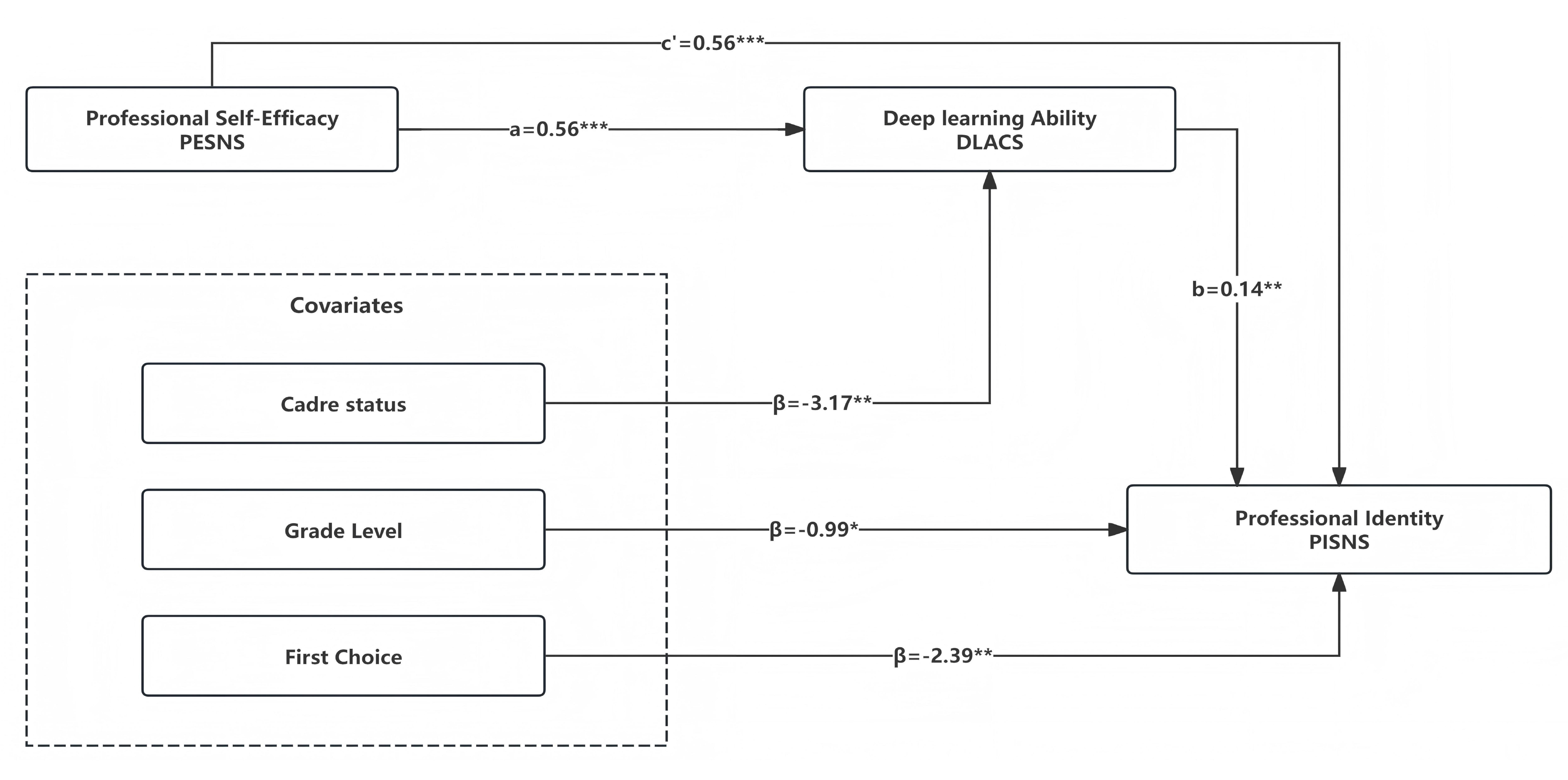
Mediation model of DLACS in the relationship between PESNS and PISNS with significant covariates. ***p < 0.000.
Note: PISNS: Professional Identity Scale for Nursing Students; PSENS: Professional Self-Efficiency Scale for Nirsing Students; DLACS: Deep Learning Ability Scale for College Students.
4. DISCUSSION
The study found that nursing students showed moderate levels of professional self-efficacy, deep learning ability, and professional identity, which aligns with prior studies [27]. Some research reported a temporary increase in professional identity during the pandemic [28]. But most studies suggest that professional identity has stayed at a moderate level for a long time [29]. This shows how difficult it is to build a strong professional identity among nursing students, which highlights the need to take action earlier. Helping nursing students develop a strong sense of identity may encourage them to stay in the nursing profession after graduation. Nurse retention is not only a task for hospitals and health systems. Schools and Universities also play an important role in the early stage of cultivation.
Our results confirmed a significant positive correlation among the three concepts. The deep learning ability partially mediates the relationship between professional self-efficacy and professional identity. This mediating effect remained significant even when other factors were controlled. This may be interpreted as students with higher self-efficacy are more likely to adopt deep learning approaches. Through their deep learning, they construct a powerful network of complex knowledge and become more skilled at solving clinical problems. The positive emotional feedback can further strengthen their confidence and clarify their identity as nurses [30].
These findings have direct implications for nursing education. Curricula should move beyond knowledge transmission to actively cultivate deep learning abilities [31]. For example, teachers can link theory with practice and encourage students to reflect on clinical experiences. After guiding students with enough reflective practices, instructors provide different problem-solving practices in real or simulated settings. This will help strengthen their deep learning skills. Furthermore, evaluating teaching based on students’ deep learning outcomes could also improve nursing programs [32].
When considering a deep learning teaching strategy, educators should be more careful. Although online learning has become widespread in recent years, fostering deep learning in digital formats can be challenging. Course design, meaningful interactions, and learning assessment are all needed to be considered comprehensively [33]. Research indicates that clear guidelines and sufficient time for peer discussion are important in online environments [34]. Digital tools may also be helpful when used appropriately [35].
In contrast, face-to-face classes benefit more from a supportive and collaborative atmosphere. Such an environment promotes the kind of reflection that leads to deeper understanding. Increasing educational practice evidence shows that a blended approach may be the most effective way. Because it can address students' variable needs [36].
According to the results, nursing students should take part in deep learning activities more often. It can help them reflect on what they learn and apply knowledge and skills in different situations. On the other hand, Educators should integrate deep learning theories and relevant metrics into course design. Clear guidance, active learning tasks, new teaching methods, and proper use of technology and AI tools can all support this goal [37].
An unexpected finding was that students who served as student leaders showed lower deep learning ability, possibly because of role overload [38]. These students may spend much time on management tasks, which reduces the time and mental energy needed for deep learning. In addition, senior students and those who did not choose nursing as their first choice demonstrated significantly lower professional identity. For senior students, this may be related to the “reality shock” and emotional depletion and pressures experienced during clinical practice. When real work conditions do not match their idealized expectations, they can not handle these conflicts effectively [39]. For students who entered nursing without a strong interest, conflict between personal goals and external pressure may weaken their sense of professional identity [40]. More research is needed to understand these issues.
5. IMPLICATIONS
This study confirms that deep learning ability plays a partial mediating role in the development of professional identity of nursing students, filling the gap in this research area. But for further understanding of deep learning in the nursing field, following directions is worth exploring in the future. Future researchers could try to develop a tool specific to assessing nursing students’ deep learning ability. Nursing educators are responsible to construct a clear framework of deep learning in nursing education practice. Subsequently, examine how courses based on deep learning theory affect nursing competence. It may also be useful to evaluate teaching effectiveness from the perspective of deep learning outcomes. Researchers can also build an assessing framework for the deep learning ability of nursing educators in the future.
6. LIMITATIONS
We have to acknowledge that there are several limitations of this study. The sample came from a single city in China, which limits how widely the results can be applied. The tool we used to assess deep learning ability was not specifically for nursing students, which means it may affect accuracy. The sample size of this study is small, which may limit the stability of subgroup analyses. Some potential influences on professional identity might be neglected.
CONCLUSION
Deep learning ability is an important process to enhance professional self-efficacy and develop professional identity. The mediating role of deep learning ability examined in this study provides a direction for nursing educational exploration. In future nursing education, deep learning ability may be considered as a key competence and evaluation indicator. Future research should continue to refine its meaning, measurement, and development in the changing context of nursing education.
AUTHORS’ CONTRIBUTIONS
The authors confirm their contribution to the paper as follows: Y.X., Y.L., H.Y.: Study design; Y.L., X.L., J.K., W.X.: Data collection; Y.X., H.Y., L.P.: Analysis; Y.X., J.K.: Manuscript preparation; Y.X., H.Y.: Critical revision.
LIST OF ABBREVIATIONS
| PISNS | = Professional Identity Scale for Nursing Students |
| PSENS | = Professional Self-Efficacy of Nursing Students |
| DLACS | = Deep Learning Ability Scale for College Students. |
ETHICS APPROVAL AND CONSENT TO PARTICIPATE
This study was approved by the Medical Ethics Committee of Kunming University (Approval No.: 2024014; Approval date: December 11th, 2023).
HUMAN AND ANIMAL RIGHTS
All procedures performed in studies involving human participants were in accordance with the Declaration of Helsinki and the ethical standards of the institutional committee.
AVAILABILITY OF DATA AND MATERIALS
The data and supportive information are available within the article.
ACKNOWLEDGEMENTS
The authors would like to thank the students who participated in this research and the colleagues who helped in the research process.